


General
Publications & Data
Join the conversation
Social Links


Social Links

This report summarises the key domestic and international data releases over the past week, including South Africa’s latest PMI data. The BER Weekly Review also unpacks the latest geopolitical developments, alongside a detailed South African political update by Natasha Marrian. The full Weekly is available to BER Essential Insights subscribers (sign up here for only R210/month) and Premium Insights clients.
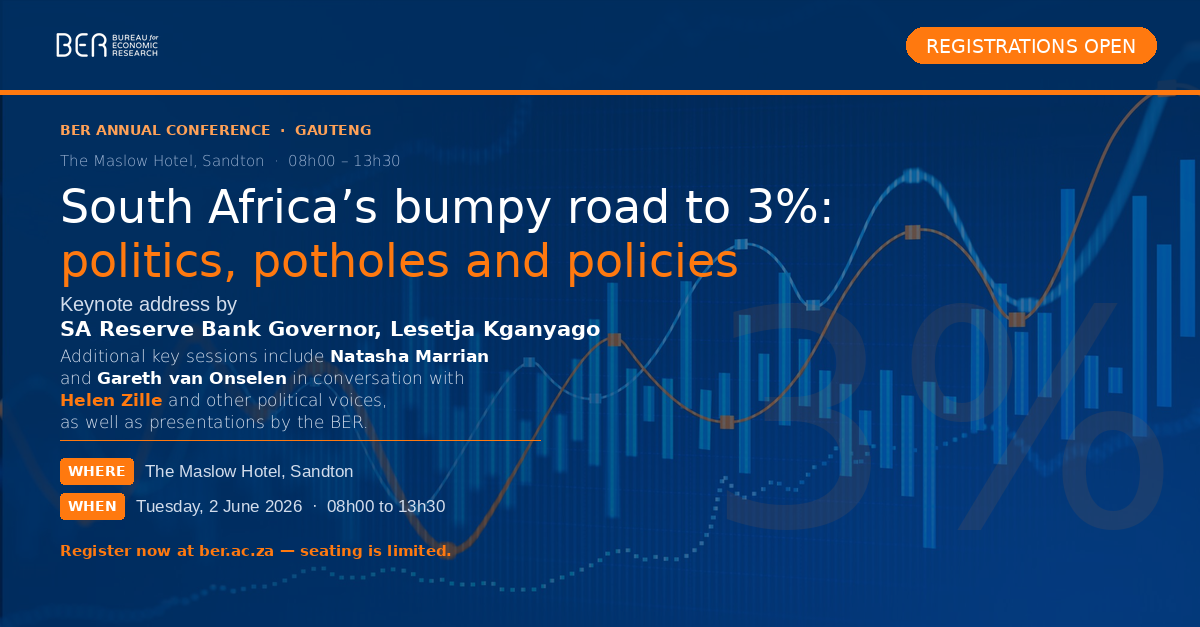
Please also note that registrations for the BER Conference on 2 June are now open. Readers who purchase both a conference ticket and an annual Essential Insights subscription qualify for a discounted package
.
It was a data-light week for the South African economy, and, reassuringly, a positive one. The Absa PMI rose from 49 to 52.6, moving firmly above the neutral 50 mark and signalling an expansion for the first time since September 2025. This improvement was mainly driven by rebounds in business activity and new sales orders, pointing to a stronger start to Q2 after a weak Q1. Inventories also increased in April. Expected business conditions also improved somewhat in April, although the index remained in contractionary territory. However, the purchasing prices index rose to 85.6 and now stands more than 30 points above the low levels seen at the start of the year, reflecting higher oil-linked input costs and a slightly weaker rand. Indeed, the combined rise in inventories, purchasing prices and activity may suggest some front-loading drove the rise in demand, which could thus be short-lived.
The S&P Global South Africa PMI was broadly aligned with the Absa PMI. The headline index increased from 50.8 to 51.6, also signalling improved business conditions. One of the key concerns from this PMI was the fastest rise in input prices in 30 months, driven by higher input costs and fuel prices. Demand levels also improved, supported by anticipated shortages and the front-loading of purchases. Unlike the Absa results, employment rose for the third consecutive month. Expected business conditions also improved for the first time in five months, although broader geopolitical conditions remain a concern.
According to naamsa, new vehicle sales rose by 5 512 units to reach 47 979 units for the year to date. This was the best April performance since 2013. On a seasonally adjusted basis, however, sales growth ticked along by just 0.1% m-o-m. Export sales have been very volatile on a monthly basis and were down by 4% y-o-y in April. The stronger domestic performance continues to be supported by lower interest rates and improved sentiment, but Naamsa cautioned that macroeconomic headwinds, particularly elevated energy prices, anticipated higher inflation and a potential reversal in interest rates, may slow this momentum.
The ISM services PMI eased from 54 in March to 53.6 in April, slightly below market expectations of 53.7, but the 22nd consecutive month of expansion. The subindexes had mixed results: business activity rose to 55.9 in April from 53.9 in March, while new orders fell to 53.5 from 60.6 in the previous month. The price index remained unchanged at 70.7 in April, following a 7.7-point rise in March, compared to February, when the energy price surge first hit the region. Meanwhile, the ISM manufacturing print remained unchanged, at 52.7, from March. While slightly below market expectations of 53, the result marked the fourth consecutive month of expansion, signalling the sector’s resilience. Three of the five core subindexes, namely new orders, production and supplier deliveries, were in the expansionary territory, while employment and inventories were in contraction.
Job openings edged lower to 6.87 million in March from 6.92 million in February, slightly above the 6.84 million expected by the market. Openings declined in professional and business services but increased in finance and insurance. Overall, job openings were lower than both February levels and the 2025 average, suggesting some cooling in labour demand and a slowing of hiring momentum. However, the broader picture remains relatively stable, as the decline in openings was marginal. Hiring actually increased during the month, although this was offset by a rise in total separations (quits and layoffs). The nonfarm payrolls due later today will provide a better picture of the health of the labour market.
The RatingDog Composite PMI rose from 51.5 in March to 53.1 in April as business activity increased across the manufacturing and services sectors. This was supported by higher new orders and larger outstanding work, suggesting that demand remains strong, while employment fell slightly from March. Cost pressures rose further in April amid a sustained surge in global oil prices, and manufacturing firms subsequently raised selling prices, passing the higher costs on to consumers, enabling charge inflation to rise to a 31-month high. Conversely, service providers lowered their prices because overall cost burdens remained manageable.
Eurozone (EZ) producer prices rose by 2.1% y-o-y in March, following the 3% y-o-y decline in February. This exceeded market expectations of 1.8% y-o-y and marked the steepest increase since March 2025. Similarly, prices rose by 3.4% m-o-m in March, rebounding from the 0.6% m-o-m decline in February. This marked the sharpest monthly rise since August 2022, driven mainly by a 11.1% surge in energy prices. Last week, preliminary consumer inflation data showed a 3% y-o-y jump in April.
Meanwhile, retail sales increased by 1.2% y-o-y in March, following a 1.3% y-o-y rise in February, marking the weakest growth since July 2024. Although food, drink and tobacco sales increased by 0.8% y-o-y, and non-food product sales rose by 2.3% y-o-y, automotive fuel sales declined by 2.1% y-o-y, due to rising fuel costs triggered by the war. Retail sales contracted by 0.1% m-o-m in March, marking the third sequential monthly decrease.

Friday, 08 May 2026

